 USD ($)
 INR (₹)
 SAR (SAR)
 AED (AED)
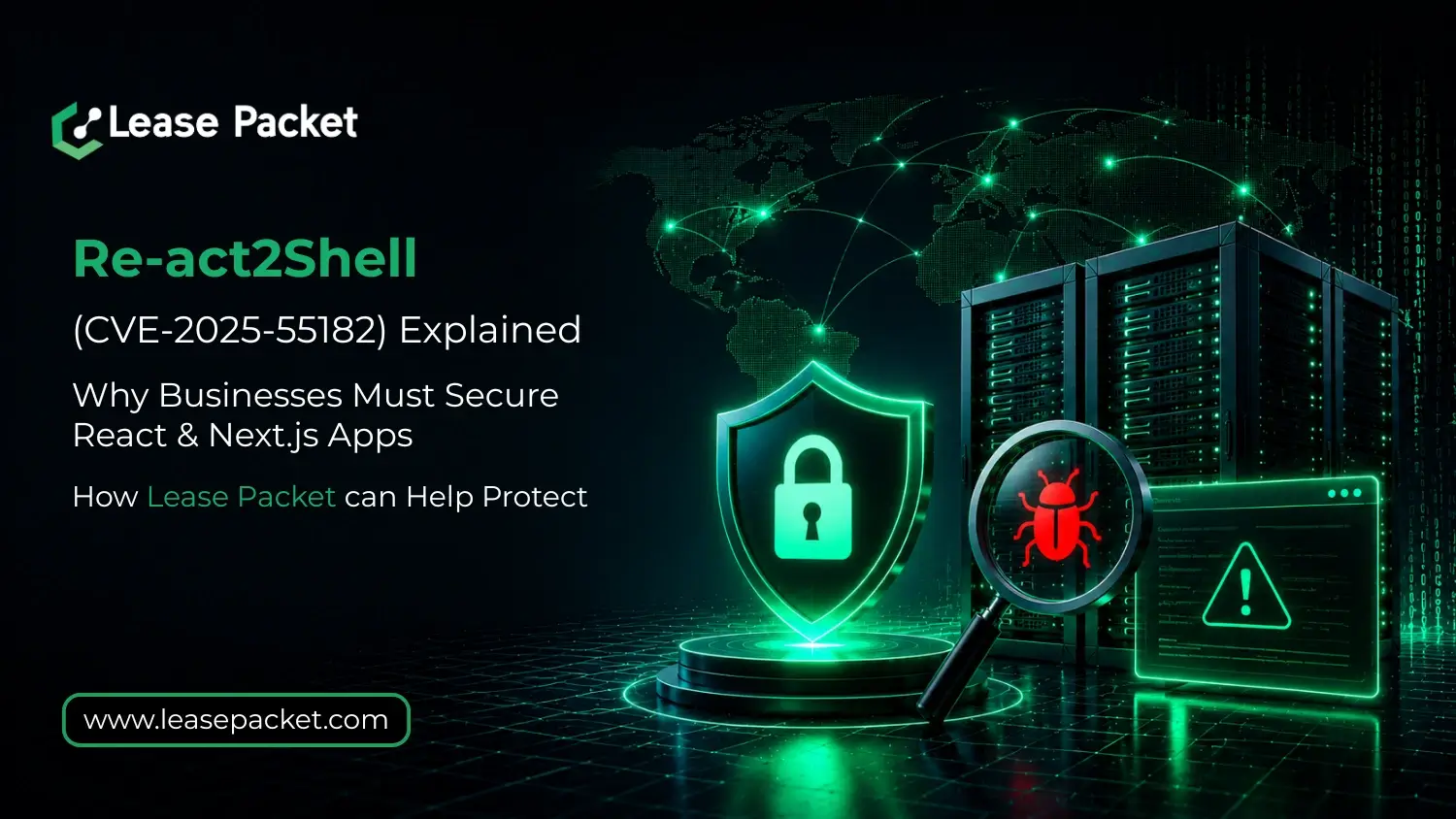
Does your business rely on React, Next.js, or anything built with React Server Components (RSCs)? If yes, you should know that you are operating on something where one silent vulnerability can rewrite your entire risk profile. The new Re-act2Shell (CVE-2025-55182) vulnerability isn’t just another patch note. It’s a maximum-severity RCE flaw powerful enough to let attackers execute code on your server environment without triggering anything obvious. That single line tells you why businesses must treat this threat with utmost seriousness. The issue hits every company that has built modern, component-driven interfaces over the last two years. Obviously, React and Next.js have become the backbone of thousands of SaaS apps, enterprise dashboards, consumer portals, and internal tools. Yes, that also means the blast radius of this vulnerability is extremely wide. If your applications use React Server Components on unsupported or older versions, you have technically been living with an open door. But fear not, there are solutions. Let’s learn more about them and how Lease Packet can help you protect with this.
Table of Contents
What Exactly is Re-act2Shell (CVE-2025-55182)?
Re-act2Shell is a Remote Code Execution vulnerability that affects applications built using React Server Components and frameworks like Next.js, especially before the patched versions (React ≥ 19.2.1 and Next.js ≥ 16.0.7). What does it mean? This flaw allows an attacker to execute arbitrary commands on the hosting server. But wait, read this carefully: the exploit triggers through seemingly normal component actions. Meaning the scary part is how silently it can slip in. Well-crafted payloads can bypass basic validation and make applications behave in ways developers didn’t expect. Obviously, when the exploit lives inside core rendering logic, the risk multiplies. Yes, this is why developer teams worldwide are being told to upgrade immediately. This is an industry-wide vulnerability.
Why This Vulnerability is More Dangerous for Businesses Planning to Go Big in 2026
The biggest concern isn’t the vulnerability itself. It’s the environment in which businesses operate today. React and Next.js power everything from payment portals to customer dashboards to multi-tenant SaaS platforms. When your front-end rendering interacts deeply with server components, the attack surface is naturally bigger. That means if someone manages to inject malicious commands inside your rendering pipeline, you are looking at full system compromise. Sad, but this is what it is. These are the real risks for businesses:
- Data theft from misconfigured or breached server environments
- Ransomware injection through malicious server-side execution
- Compromised user sessions
- Unauthorized API access
- Full server takeover in unmanaged hosting setups
Yes, these outcomes are not theoretical. Analysts studying the vulnerability have already flagged PoC exploits circulating in dev communities worldwide.
Why Patch Management Alone isn’t Enough
Of course, upgrading React and Next.js versions is the first step. Do it now if you haven’t yet. But thousands of companies underestimate what happens after patching. If your infrastructure isn’t configured properly, or your app relies on cached builds, container layers, or CI/CD pipelines that still use older dependencies – the threat stays alive. Repeating, the threat stays alive. Even businesses with internal dev teams often miss nested dependencies or outdated micro-services. This is where having a secure hosting partner matters, not just a framework patch.
How Lease Packet Protects Your Applications Against Re-act2Shell
Lease Packet can help you provide the expert support you need to fix this issue entirely – future-proofing your systems. Vulnerabilities like Re-act2Shell are mitigated in multiple layers. And you get systems hardened for modern JavaScript frameworks. That’s how Lease Packet helps:
Patched, Framework-Ready Server Environments
Yes, Lease Packet’s environments support the latest secure versions of React and Next.js without compatibility issues.
Security Hardening Across Application Layers
Your server, network, and application stack get configured to block exploitation attempts before they reach your app.
Real-Time Vulnerability Monitoring
Obviously, threats evolve, and Lease Packet tracks those changes so your infrastructure isn’t left behind.
Developer-Friendly Deployment Pipelines
Of course, teams get assistance ensuring their CI/CD pipelines deploy updated, secure builds after patching.
Dedicated Support for Front-End + Server Components
Yes, many hosting companies don’t understand React Server Components. Lease Packet does.
The Bigger Picture for 2026
There’s a clear shift happening. Businesses now realize that framework-level vulnerabilities can cripple entire operations if hosting infrastructure isn’t built to withstand them. A security-first approach is what you need in the coming year. When frameworks evolve as fast as React and Next.js, your hosting partner must evolve too.
Bottom Line
The Re-act2Shell (CVE-2025-55182) outbreak is a reminder that your application security is only as strong as the environment running it. If your business uses React, Next.js, or similar stacks, you must secure your hosting layer with a provider that understands these frameworks deeply. Partner with Lease Packet to protect your applications with hardened servers, secure deployments, and proactive vulnerability mitigation. So, safeguard your React and Next.js apps today, connect with Lease Packet to learn more.
FAQs
Do I need to update my React and Next.js versions immediately?
Yes, right away! The Re-act2Shell vulnerability affects older versions, so updating to React 19.2.1+ and Next.js 16.0.7+ is the safest move to avoid RCE risks.
Can hosting providers help prevent this type of attack?
Of course! A secure infrastructure with hardened servers, monitoring, and updated environments – like what Lease Packet offers – can block exploitation attempts even before they reach your app.
What if my app uses multiple micro-services or older components?
That’s exactly where issues hide. Lease Packet’s team can help you audit, patch, and redeploy your full stack so outdated components don’t leave open doors.