 USD ($)
 INR (₹)
 SAR (SAR)
 AED (AED)

What is a Google Workspace?
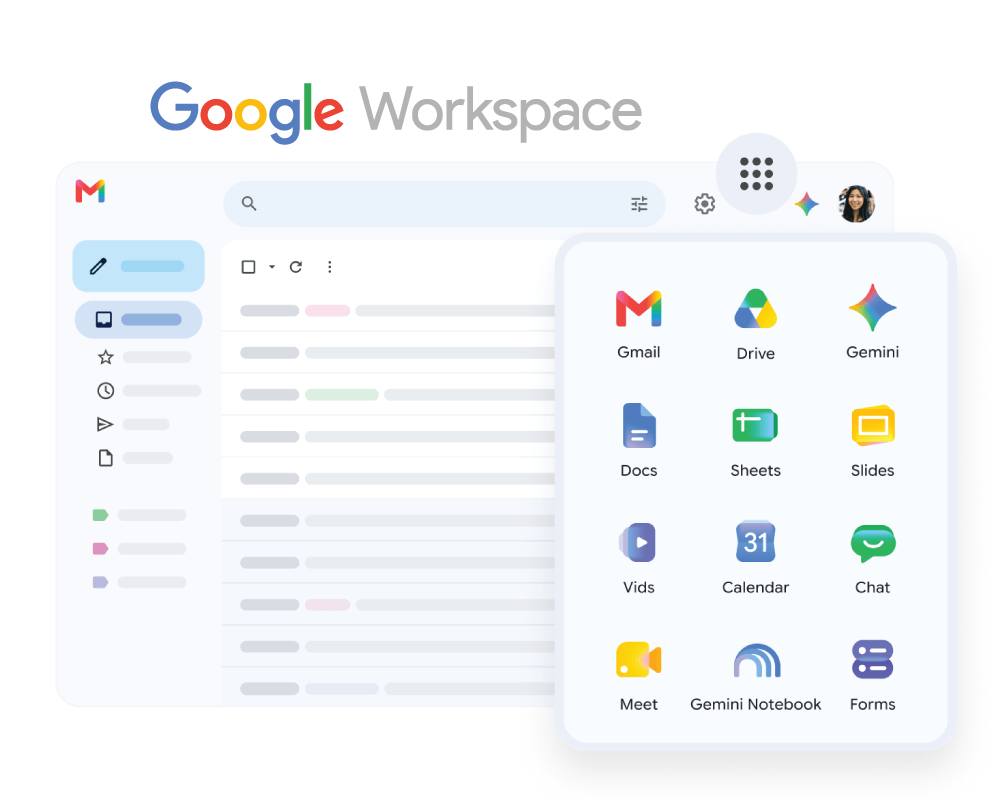
Google Workspace is Google’s subscription suite of cloud productivity and collaboration tools for organizations, combining business email on your own domain (Gmail) with Drive storage, Meet video calls, Docs, Sheets and Slides, Calendar, Chat, an admin console and Gemini AI features. It was formerly called G Suite.
Unlike a free Gmail account, Workspace gives an organization its own domain addresses, central administration, security controls and a service level agreement. Features, storage and AI access depend on the edition you choose.
Quick answer
Definition
Google's paid suite of cloud tools for organizations: Gmail on your domain, Drive, Meet, Docs, Sheets, Slides, Calendar, Chat and an admin console.
Main advantage
Real-time collaboration, business email on your own domain and central administration, without running servers.
Main limitation
Recurring per-user cost, dependence on Google's platform, and features that differ by edition.
Best suited for
Teams that work in a browser, collaborate on documents and want managed business email and security controls.
What is Google Workspace?
Google Workspace is a subscription suite of cloud-based productivity, communication and collaboration tools from Google, designed for businesses, schools and other organizations to use with their own domain and central administration.
Instead of installing and maintaining software and mail servers, an organization subscribes, adds its users and uses the apps in a web browser or on mobile and desktop clients. Google runs the infrastructure, and an administrator manages users, security and settings from one console.
- Email on your domain: Gmail with addresses such as name@yourcompany.com, instead of @gmail.com.
- Shared storage and files: Drive, including shared drives that belong to a team.
- Documents that several people edit: Docs, Sheets and Slides with real-time collaboration.
- Meetings and messaging: Meet, Chat and Calendar.
- Administration: an admin console for users, groups, devices, policies and reports.
- AI features: Gemini access and in-app features, with levels that depend on the edition.
Terminology note
The product has had several names: Google Apps for Your Domain (2006), G Suite (renamed in September 2016) and Google Workspace (renamed in October 2020). Older articles and some partner pages still say "G Suite". A Google Workspace account belongs to an organization and its domain, while a free Google Account is a personal account.
Google Workspace terms explained
A handful of terms explain most Workspace quotes and documentation: edition, user, domain, MX record, admin console, shared drive, Vault, two-step verification and Gemini.
| Term | What it means |
|---|---|
Edition |
A plan level (for example Business Starter, Standard, Plus or Enterprise) that sets storage, features and limits. |
User (licence) |
One person with a Workspace account. Most editions are priced per user. |
Domain |
Your web address, such as yourcompany.com, which you must own and verify to use it for Workspace email. |
MX record |
A DNS record that tells other mail servers where to deliver mail for your domain. Pointing it to Google routes your mail to Gmail. |
Admin console |
The web interface where administrators manage users, apps, devices, security and billing. |
Pooled storage |
Storage allotted per user but shared across the organization. |
Shared drive |
A Drive space owned by a team rather than an individual, so files stay when a person leaves. |
Vault |
Google’s archiving and electronic discovery (eDiscovery) tool for retention and search; availability depends on edition. |
2-step verification |
A second proof of identity at sign-in, beyond the password. |
DLP |
Data loss prevention: rules that detect and block sharing of sensitive data. Listed by Google as an Enterprise feature. |
Gemini |
Google’s AI assistant, offered in Workspace with different levels of access by edition. |
Reseller / partner |
A company authorized to sell and support Google Workspace subscriptions. |
What is included in Google Workspace?
Google Workspace includes email, calendar, chat and video meetings, file storage, document editors, forms, sites, notes, tasks and an admin console, with some apps and limits depending on the edition.
| Category | Apps | What you use them for |
|---|---|---|
Communication |
Gmail, Contacts, Calendar, Meet, Chat |
Business email on your domain, scheduling, video meetings and team messaging |
Storage |
Drive (including shared drives) |
Storing, sharing and syncing files |
Content creation |
Docs, Sheets, Slides, Forms, Drawings |
Documents, spreadsheets, presentations, surveys and diagrams |
Other tools |
Keep, Sites, Tasks, Vids, Apps Script |
Notes, simple websites, to-dos, video creation and custom automation |
Administration and compliance |
Admin console, Vault (edition-dependent) |
User and device management, retention and eDiscovery |
Add-ons (sold separately) |
Voice, AppSheet, Meet hardware, Chrome Enterprise, AI Expanded Access |
Telephony, no-code apps, meeting-room hardware, managed browsers, extra AI access |
Google adds, renames and retires apps over time; for example, Jamboard was discontinued at the end of 2024. Check Google’s current product list.
How does Google Workspace work?
Google Workspace works as a hosted service: you sign up for an edition, verify your domain, create user accounts, point your domain’s mail records to Google, and your team then uses the apps online while an administrator manages them.
Choose an edition and user count
Pick the plan that matches your storage, meeting, security and AI needs, and the number of people who need accounts.
Sign up and verify your domain
Prove that you own the domain, typically by adding a DNS record that Google provides.
Create users and groups
Add accounts, organise them into groups and organizational units, and set roles for administrators.
Set up email routing
Add the MX record at your domain registrar or DNS host and activate Gmail for the domain. Plan this step with care so that mail is not lost.
Migrate existing data
Move mail, contacts, calendars and files from the old system, using migration tools or a partner.
Secure and manage
Turn on 2-step verification, set sharing and device policies, configure email authentication and review reports.
Key facts at a glance
Former names
|
Google Apps for Your Domain (2006), G Suite (2016), Google Workspace (2020) |
Business editions user range
|
1 to 300 users (Starter, Standard, Plus); Enterprise has no user limit (Google) |
Pooled storage per user (Google)
|
Starter 30 GB · Standard 2 TB · Plus 5 TB · Enterprise 5 TB, with more on request |
Uptime commitment (Google SLA)
|
At least 99.9% in any calendar month for covered services |
What 99.9% allows |
0.1% of a 30-day month is 43.2 minutes (30 × 24 × 60 × 0.001) |
MX setup |
One MX record with priority 1 pointing to smtp.google.com; changes can take up to 72 hours to propagate (Google) |
Last reviewed |
14 October 2026 |
Editions, limits and prices change. Figures above come from Google’s pages (see sources); confirm the current text before you buy.
Google Workspace editions compared
Google sells Workspace in Business editions (Starter, Standard and Plus) for up to 300 users and an Enterprise edition with no user limit, and they differ mainly in storage, meeting capacity, Gemini access, endpoint management and security features.
| Per Google's pricing page | Business Starter | Business Standard | Business Plus | Enterprise |
|---|---|---|---|---|
Pooled storage per user |
30 GB |
2 TB |
5 TB |
5 TB, more on request |
Meet participants |
100 |
150 |
500 |
1,000 |
Meet recording to Drive |
No |
Yes |
Yes |
Yes |
Gemini in Workspace apps |
Limited (Gmail and Vids) |
Full |
Full |
Full |
Endpoint management |
Fundamental |
Fundamental |
Advanced |
Enterprise |
2-step verification, group policies |
Included |
Included |
Included |
Included |
DLP, context-aware access, S/MIME, data regions |
No |
No |
No |
Listed for Enterprise |
User limit |
300 |
300 |
300 |
None |
- Essentials and other editions: Google also offers Essentials editions without Gmail, plus Education, Nonprofit and Frontline options. Check Google's edition comparison for details.
- Vault: archiving and eDiscovery are provided on higher editions; confirm which in Google's comparison.
- Prices: Google lists prices per user in its own pricing page, with monthly and annual commitments. Amounts vary by edition, region and currency, so this guide does not quote them.
Table values are as published on Google’s pricing page on 14 October 2026 and may have changed.
Google Workspace vs free Gmail
Free Gmail is a personal account with @gmail.com addresses and no administrator, while Google Workspace is a paid business service with addresses on your own domain, central administration, security controls and a service level agreement.
| Feature | Google Workspace | Free Gmail |
|---|---|---|
Email address |
Your domain (name@yourcompany.com) |
@gmail.com |
Who controls the account |
The organization’s administrators |
The individual |
Admin console and policies |
Yes |
No |
Storage |
Pooled, from 30 GB per user upward by edition |
A shared free allowance across Google services (currently 15 GB) |
Team shared drives |
Yes |
No |
Security controls |
Organization-wide, including enforced 2-step verification |
Per-user settings |
Service level agreement |
99.9% monthly uptime commitment for covered services |
None for consumer accounts |
Support |
Business support options |
Help center and community |
Cost |
Per user subscription |
Free |
Using a personal Gmail account for a business makes it harder to control access when staff leave, and a custom domain address looks more professional to customers.
Google Workspace vs Microsoft 365
Google Workspace is built around browser-based apps and real-time collaboration, while Microsoft 365 centers on the Office desktop applications with cloud services, and the better choice depends on your existing tools, file formats and skills.
| Consideration | Google Workspace | Microsoft 365 |
|---|---|---|
Core approach |
Web-first apps and collaboration |
Office desktop and web apps with cloud services |
Email and calendar |
Gmail and Google Calendar |
Exchange Online and Outlook |
Documents |
Docs, Sheets, Slides |
Word, Excel, PowerPoint |
Meetings and chat |
Meet and Chat |
Teams |
Storage |
Drive and shared drives |
OneDrive and SharePoint |
File compatibility |
Opens and edits many Office formats; complex macros and layouts may differ |
Native Office formats and macros |
Administration |
Admin console |
Microsoft 365 admin center and related tools |
Best fit |
Teams that collaborate in the browser and want simplicity |
Organizations deeply invested in Office files, macros or Microsoft tools |
Both are mature, and a pilot with real users is the most reliable way to decide. Pricing differs by plan and region, so compare current quotes for equivalent editions.
Benefits of Google Workspace
The main benefits are business email on your own domain, real-time collaboration, no servers to maintain, central administration and security controls, and access from any device with a browser.
Professional email
Addresses on your own domain with Gmail's interface and spam filtering.
Real-time collaboration
Several people can edit the same document, spreadsheet or presentation at once.
No infrastructure to run
Google hosts and updates the service, so you do not maintain mail servers.
Central administration
Create and remove accounts, apply policies and review activity from one console.
Security controls
2-step verification, sharing rules, device management and, on higher editions, DLP and context-aware access.
Works across devices
Use it in a browser or on phones, tablets and computers.
Scales with the team
Add or remove users as the organization changes.
AI assistance
Gemini features can help draft, summarize and organize, depending on edition and admin settings.
Limitations of Google Workspace
The main limitations are the recurring per-user cost, dependence on Google’s platform and internet access, differences from desktop Office files and macros, and features that are only available on higher editions.
Recurring cost
Subscriptions are charged per user for as long as you use the service.
Platform dependence
Your data and workflows live on Google's platform, so moving later takes planning.
Internet dependence
Some apps offer offline modes, but the experience is built around being online.
Office compatibility gaps
Complex Excel macros, formatting and add-ins may not convert perfectly.
Edition limits
Security, AI and storage features differ, so the cheapest edition may not fit regulated needs.
Change management
Teams used to another suite need training and time to adapt.
Workspace is a good fit for many organizations, but a pilot that includes your most complex files is the best way to find compatibility problems early.
Who uses Google Workspace?
Organizations of many sizes use Google Workspace, from startups and small businesses to enterprises, schools and nonprofits, wherever teams need shared email, files and collaboration.
Startups and small businesses
Business email on a domain and shared files without an IT team.
Why: quick setup and low operations overhead
Remote and hybrid teams
Distributed staff working in shared documents and meetings.
Why: browser-based collaboration
Agencies and consultancies
Sharing drafts and assets with clients and teams.
Why: sharing controls and real-time editing
Schools and universities
Classrooms and campus-wide accounts using education editions.
Why: education-specific editions and tools
Nonprofits
Email and collaboration for staff and volunteers.
Why: programs and editions for eligible organizations
Mid-size and large enterprises
Company-wide email and collaboration with governance.
Why: Enterprise controls, data regions and DLP
Frontline and shift workers
Staff who need email and basic tools but not a full desk setup.
Why: lighter editions for frontline use
Companies migrating from on-premises mail
Moving from self-hosted mail servers to a managed service.
Why: removes server maintenance
Situations where another option may fit better
Teams that depend on desktop Office macros, specialized Windows software or strict on-premises data requirements may prefer another suite or a self-hosted mail server.
When should you switch to Google Workspace?
Consider Google Workspace when you need business email on your own domain and shared collaboration tools, or when you want to stop maintaining your own mail servers or using personal accounts for work.
Signals it may be time to switch
- Staff use @gmail.com or other personal addresses for company work.
- You run your own mail server and spend time on maintenance, spam and outages.
- Files are scattered on laptops and email attachments with no version control.
- You cannot easily remove access when someone leaves.
- Teams edit documents together and want one live version.
- You need central security policies and reports.
- You want a service level agreement for email and collaboration.
- You are growing and need to add users quickly.
Before you decide, list the apps and file types you rely on, run a pilot with a small group and compare the total cost with your current setup.
Security, privacy and compliance
Google secures the platform and offers admin controls, but security in Google Workspace is shared: you are responsible for how accounts, sharing, devices and email authentication are configured.
2-step verification
Listed by Google for all editions; enforce it for every user.
Admin policies
Group-based policy controls for apps, sharing and devices.
Data loss prevention
Listed by Google for Enterprise editions, to identify and protect sensitive data.
Context-aware access
Listed for Enterprise editions, to limit access based on user and device context.
Encryption options
Google describes client-side encryption controls; S/MIME is listed for Enterprise. Check availability by edition.
Data regions
Enterprise editions list data regions; Assured Controls is an add-on. Confirm what each covers.
Email authentication
Set up SPF, DKIM and DMARC for your domain to protect it from spoofing and to meet bulk-sender rules.
Backups and retention
Plan retention and backup for Gmail and Drive; Vault is for retention and discovery, and availability depends on edition.
Privacy and compliance
- Audits and certifications: Google states that Workspace undergoes independent third-party audits and publishes compliance information. Read its current compliance pages for the specific certifications you need.
- Advertising: Google states that it does not use Workspace customer data for advertising; read its current terms and privacy notices to confirm.
- Your obligations: using Workspace does not by itself make you compliant with GDPR, India's DPDP Act, the UAE PDPL or sector rules such as HIPAA. Take advice and review the agreements that apply.
Reliability and the Google Workspace SLA
Google’s Workspace service level agreement commits to a monthly uptime of at least 99.9% for covered services, and offers service credits if that is missed, which is a commitment with remedies and not a promise of no downtime.
| SLA element (per Google's SLA) | Detail |
|---|---|
Uptime commitment |
At least 99.9% in any calendar month. |
What 99.9% means |
0.1% of a 30-day month, about 43.2 minutes. |
Covered services |
Includes Gmail, Calendar, Chat, Docs, Drive, Forms, Meet, Sheets, Sites, Slides, Vault and others. |
What counts as downtime |
A period with more than a five percent user error rate, measured server-side. |
Service credits |
Days of service added: 3 days (below 99.9% to 99.0%), 7 days (below 99.0% to 95.0%), 15 days (below 95.0%). |
Claiming credits |
File a support case within 30 days of becoming eligible. |
Exclusions |
Includes Essentials Starter edition, force majeure and customer-side issues. |
If you buy through a partner, ask who handles support cases and SLA claims, and what the partner adds. Keep your own backups for critical data.
Gemini and AI in Google Workspace
Google Workspace includes Gemini AI features, and the level of access depends on the edition: Google lists limited Gemini in apps for Business Starter and fuller access in Business Standard, Business Plus and Enterprise.
- What it does: assists with drafting, summarizing, searching and organizing content in apps such as Gmail, Docs and Meet.
- Edition differences: Google's pricing page lists Gemini in Workspace apps as limited (Gmail and Vids) on Business Starter and full on higher editions, plus different daily limits for some features.
- Add-ons: Google lists an "AI Expanded Access" add-on sold separately.
- Admin control: administrators can manage which AI features are available. Review data handling terms before using AI with sensitive content.
- Change is frequent: AI features and limits are updated often, so check Google's current documentation.
Setting up and migrating to Google Workspace
Setting up Google Workspace means verifying your domain, creating users, pointing your MX records to Google and migrating existing mail and files, and the order matters so that no mail is lost.
Inventory what you have
Mailboxes, sizes, shared mailboxes, aliases, calendars, files and integrations.
Confirm domain control
Access to the registrar or DNS host so you can add verification and mail records.
Verify the domain
Add the verification record Google provides before activating Gmail.
Create users and groups
Match addresses, aliases and groups to your current setup.
Plan the MX switch
Google's MX setup uses one record with priority 1 to smtp.google.com and removes other MX records; changes can take up to 72 hours.
Migrate data
Move mail, contacts, calendars and files with migration tools or a partner, and test with a pilot group first.
Set email authentication
Configure SPF, DKIM and DMARC for the domain.
Turn on security policies
Enforce 2-step verification, sharing limits and device rules.
Train the team
Short guides for Gmail, Drive and Meet, and a point of contact for questions.
Keep the old system briefly
Retain it read-only until you have verified the migration.
How much does Google Workspace cost?
Google Workspace is priced per user per month, and the cost depends on the edition, the number of users, the billing term, the region and currency and whether you buy directly from Google or through a partner, so there is no single price.
Edition
Starter, Standard, Plus and Enterprise are priced differently.
Number of users
Priced per user; Business editions are limited to 300 users.
Billing term
Google lists monthly billing and an annual commitment option.
Region, currency and tax
Prices vary by country and may exclude taxes such as GST or VAT.
Add-ons
AI Expanded Access, Voice, AppSheet, Meet hardware and others are separate.
Migration and setup
One-time work for data migration, DNS and training.
Support and management
Partner support, managed administration or consulting may add cost.
Backup and security add-ons
Third-party backup or email security tools.
Reseller terms
Invoicing, discounts and contract terms differ by partner.
Why this guide quotes no prices
Prices on third-party pages often disagree, because they reflect different dates, regions, billing terms and editions. Always check the current price on Google's own pricing page or in a written quote, and compare like for like: the same edition, user count, term, currency and tax treatment.
Buying from Google directly or through a reseller
You can buy Google Workspace directly from Google or through an authorized reseller or partner, and the subscription is the same product, with differences in billing, support, local currency and services such as migration.
| Consideration | Directly from Google | Through a reseller or partner |
|---|---|---|
Billing |
Google’s billing and currencies |
Partner’s invoicing, possibly local currency and terms |
First-line support |
Google’s support options |
Partner support, often with local hours and language |
Migration help |
Self-service tools and documentation |
Often offered as a service |
Pricing |
Google’s published prices |
Varies by partner; do not assume it is cheaper or dearer |
Bundles |
Google products |
May combine with hosting, security and other services |
Things to confirm |
Admin and billing setup |
Who holds the admin account, how to switch partners and how support cases are escalated |
Whichever route you choose, make sure your own organization has a super administrator account and controls its data and domain, and ask in writing how you could move to another partner or to Google directly.
How to choose a Google Workspace edition
Choose an edition by listing your storage, meeting size, AI, security and compliance needs, then picking the lowest edition that meets all of them, and review it as the organization grows.
Number of users
Business editions are limited to 300; larger organizations need Enterprise.
Storage per user
30 GB, 2 TB, 5 TB or more, pooled across the organization.
Meeting size and recording
Participant limits and whether you need recordings in Drive.
AI needs
How much Gemini access and which apps.
Security requirements
DLP, context-aware access, S/MIME and data regions are listed for Enterprise.
Compliance and retention
Whether you need Vault, audit and retention features.
Device management
Fundamental, advanced or enterprise endpoint management.
Email requirements
Whether you need Gmail (Essentials editions exclude it).
Support level
Google's and your partner's support options.
Migration complexity
Size and type of data to move, and who will do it.
Budget and billing
Monthly vs annual, currency, taxes and add-ons.
Exit plan
How you would export your data if you leave.
Google Workspace at Lease Packet
Lease Packet is a global infrastructure provider that lists itself as an authorized Google Workspace partner and reseller, offering Google Workspace subscriptions alongside dedicated, cloud and GPU servers, email solutions and colocation from data centers in India and Dubai, UAE.

About Lease Packet.
Lease Packet (Lease Packet Datacenter Pvt. Ltd.) provides server and data center infrastructure and related services to businesses worldwide. Google Workspace is a Google product; Lease Packet resells and supports subscriptions as a partner under the terms of its agreement with the customer.
The guide above is neutral and applies to any provider. If you are evaluating Lease Packet, use the same checklist and ask in writing about the edition, price, currency and tax treatment, billing term, who holds the administrator account, support hours and how migration is handled. See current plans on the Google Workspace page.
What Lease Packet offers around Google Workspace
Google Workspace subscriptions
Business and Enterprise editions, with plans shown on the Google Workspace page.
Local billing options
Plans are offered with India and global options; currency, taxes and billing terms are confirmed in your order.
Migration and setup help
Help with moving mail and files and configuring your domain, scoped in your order.
Related email and server services
Business email hosting, email servers and mass mailing servers for needs that Workspace does not cover.
Microsoft 365 as an alternative
If your team prefers the Microsoft ecosystem.
Written terms
Edition, support scope and commercial terms are set out in your order and our SLA.
How to get Google Workspace from Lease Packet
Tell us your needs
Share your domain, number of users, current email provider, data to migrate and any security or compliance needs.
Choose an edition
Pick a plan on the Google Workspace page or ask a specialist for a recommendation and written quote.
Review the terms
Check price, currency, taxes, billing term, admin ownership, support and migration scope.
Set up and migrate
Verify the domain, create users, switch email routing and migrate data with a tested cutover plan.
Google Workspace FAQs
Google Workspace is Google’s subscription suite of cloud productivity and collaboration tools for organizations, including Gmail on your own domain, Drive, Meet, Docs, Sheets, Slides, Calendar, Chat, an admin console and Gemini AI features.
Yes, Google Workspace is the current name of the product that was called G Suite from September 2016 until October 2020, and Google Apps for Your Domain before that.
Google Workspace includes Gmail, Calendar, Meet, Chat, Drive, Docs, Sheets, Slides, Forms, Sites, Keep, Tasks and Vids, along with an admin console and Vault on some editions.
A free Gmail account is a personal account with an @gmail.com address and no administrator, while Google Workspace is a paid business service with addresses on your own domain, central administration, security controls and a service level agreement.
Yes, Google Workspace gives each user an address on your domain, such as name@yourcompany.com, as long as you own the domain and verify it with Google.
Google sells Business editions (Starter, Standard and Plus) for 1 to 300 users and an Enterprise edition with no user limit, along with Essentials editions without Gmail and Education, Nonprofit and Frontline options.
They differ mainly in storage, meeting capacity, Gemini access and device management: according to Google’s pricing page, storage is 30 GB, 2 TB and 5 TB per user, and Meet supports 100, 150 and 500 participants.
Google lists data loss prevention, context-aware access, S/MIME encryption, enterprise data regions, advanced classification for Drive and enhanced support for critical issues as Enterprise features, with no user limit.
Google Workspace Essentials editions provide collaboration tools such as Meet, Drive and Docs without Gmail, for organizations that already use another email system or only need collaboration features.
Google Workspace is priced per user per month, and the cost depends on the edition, the number of users, the billing term, the region and currency and whether you buy from Google or a partner, so check the current price before you decide.
Google’s pricing page lists an annual commitment option that costs less than month-to-month billing, but the size of the discount and the terms can change, so check the page or your quote.
Each person with a Workspace account needs a user licence, and Business editions can be bought for up to 300 users, while Enterprise has no user limit.
Storage is pooled across the organization and is allotted per user by edition: Google lists 30 GB for Business Starter, 2 TB for Standard, 5 TB for Plus and 5 TB for Enterprise with the option to request more.
Gemini is Google’s AI assistant, available in Google Workspace with different levels of access by edition, to help with tasks such as drafting, summarizing and organizing content in apps like Gmail, Docs and Meet.
Google secures the platform and provides admin controls such as 2-step verification, group-based policies and, on Enterprise, data loss prevention and context-aware access, but your own configuration determines how secure your organization is.
Google states that it does not use Workspace customer data for advertising, but you should read Google’s current terms and privacy notices to confirm how your data is handled.
Data location depends on the edition and settings: Google lists enterprise data regions as an Enterprise feature, and Assured Controls as an add-on, so smaller editions have less control over where data is stored.
Google Workspace can support compliance programs, and Google publishes audit and certification information, but using it does not by itself make your organization compliant: that depends on your configuration, agreements and processes.
Google’s service level agreement commits to a monthly uptime percentage of at least 99.9% in any calendar month for covered services, with service credits if that is not met.
The admin console is the web interface where administrators create and manage users and groups, control apps and devices, apply security policies, view reports and manage billing for a Google Workspace organization.
Choose an edition, sign up, verify your domain by adding a DNS record, create users, point your MX record to Google, activate Gmail and then migrate data and enable security policies.
MX records are DNS records that tell other mail servers where to deliver email for your domain, and pointing them to Google sends your incoming mail to Google Workspace.
After you change the MX record, Google says the change can take up to 72 hours to be recognized across the internet, although it is often much faster.
List your mailboxes, calendars and files, create the accounts, use a migration tool or a partner to move the data, test with a pilot group, switch the MX record and keep the old system until the results are verified.
Yes, if you own the domain you can keep your existing addresses and set up the same names as Google Workspace accounts or aliases.
Yes, Gmail in Google Workspace can be used with desktop email clients such as Microsoft Outlook, and Wikipedia’s summary of the product notes compatibility with Outlook.
Neither is better in every case: Google Workspace is built around browser-based collaboration, while Microsoft 365 centers on Office desktop applications with cloud services, so the better choice depends on your tools, file formats and skills.
Yes, Docs, Sheets and Slides support real-time collaboration, so several people can edit the same file at once and see each other’s changes.
Some Google Workspace apps offer offline modes, but they are designed mainly to be used online, so you need to enable and test offline access before you rely on it.
A shared drive is a Drive space owned by a team or the organization instead of an individual, so the files stay available when a member leaves.
An administrator can suspend or delete the account and transfer its files and, where supported, other data to another user, and shared drives keep team files in place, but you should set up your process and retention rules in advance.
Vault is Google’s archiving and electronic discovery tool for Workspace, used to retain, search and export data such as email and chat for legal and compliance purposes.
SPF, DKIM and DMARC are DNS records that authenticate email from your domain: SPF lists which servers may send, DKIM signs messages and DMARC sets the policy for mail that fails, and you should configure all three for your Workspace domain.
A Google Workspace reseller or partner is a company authorized by Google to sell and support Workspace subscriptions, often adding local billing, support and services such as migration.
Either route can work: buy from Google if you prefer its own billing and support and have in-house skills, and consider a reseller if you want local billing, hands-on support or migration help.
Your organization should hold the super administrator account and own its data and domain, and you should confirm this in writing with the partner before you buy.
Yes, Business editions are sold for 1 to 300 users and give small teams email on their domain, shared files and meetings without running servers.
Common mistakes are skipping 2-step verification, switching the MX record before migrating mailboxes, leaving files in personal drives, forgetting email authentication records and losing control of the domain or administrator account.
Lease Packet is a global infrastructure provider offering dedicated servers, cloud and VPS servers, GPU servers, colocation, email solutions and Google Workspace subscriptions from data centers in Globally
Yes, Lease Packet lists itself as an authorized Google Workspace partner and reseller, and its Google Workspace page shows plans with India and global options.
Choose a plan on Lease Packet’s Google Workspace page or contact the team with your domain, number of users and current email provider, and you will receive a recommendation and a written quote.
Is Google Workspace right for you?
Google Workspace is right when your team works comfortably in the browser, collaborates on documents and wants managed email on your own domain with central controls; otherwise another suite or a simple mailbox service may fit better.
Choose business email hosting if…
You need only mailboxes on your domain, without document collaboration or meetings.
Choose Microsoft 365 if…
You depend on desktop Office files, macros or Microsoft integrations.
Choose Google Workspace if…
You want email, files, meetings and documents in one browser-based suite with admin controls, and your files work well in Docs, Sheets and Slides.
Choose a self-hosted mail server if…
You have strict control requirements and the skills to run and secure it.
Moving your team to Google Workspace?
Tell us your domain, users and current email setup, and we will recommend an edition and prepare a quote. Lease Packet lists itself as a Google Workspace partner and reseller.
- No lock-in contract
- 24/7 Sales support